Last week, the Centre for Sustainable Development at the University of Tartu organised a discussion evening titled “War and Environmental Damage”, which was also attended by Aveliina Helm, head of our Landscape Biodiversity Working Group.
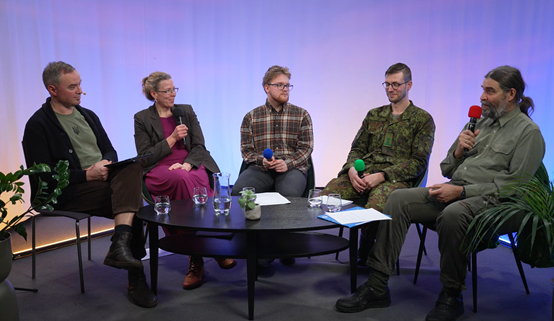
Panel discussion about wars and their environmental damage.
Together with Marko Kaasik, Associate Professor of Air Pollution Modelling at the University of Tartu; Marko Pungar, Lecturer in Tactics at the Estonian Military Academy; and Jaak Pärtel, member of the Soil Ecology Working Group, the panel discussed the long-term and often hidden environmental impacts of war. The discussion was moderated by Kristo Elias, journalist at ERR.
Several key ideas emerged from the discussion:
History shows that areas managed by the military can in fact be very rich in biodiversity, as they are not subject to the constant development of infrastructure and road networks typical elsewhere. In some cases, nature may even benefit from large military areas, despite the disturbances that occur there.
Investing in renewable energy sources is also a very smart choice from a military security perspective, as large thermal power plants are much easier to destroy than distributed wind and solar parks. Destroying dispersed production units requires significantly more precise ammunition. The example of Ukraine shows that solar panels can continue to function even when partially damaged by bullets or shrapnel, and that repairing them is relatively easy.
When restoring ecosystems, the goal is not to recreate some original historical state, but to design the most functional situation under present-day conditions. For example, if a river has been polluted during warfare, it is not realistic to restore it to the condition it was in 500 years ago. It is more reasonable to restore the functioning of the river as an ecosystem, taking into account the already changed climate and environment.
The better we are able to protect the environment in peacetime, and the healthier our soils and ecosystems are, the more resilient they will be to the military disturbances that may inevitably occur in our country.
Listen to the discussion here: